

Reclining sectionals offer more seating than a sofa and more flexibility than individual chairs, but buying one requires understanding terminology that furniture salespeople throw around like everyone knows what it means. LAF, RAF, console, armless. If you’re not familiar with sectional terminology, you’ll have a hard time ordering the right configuration.
This guide breaks down what you need to know to buy a reclining sectional that actually fits your room and works the way you want it to.
Understanding LAF and RAF
Left-Arm Facing (LAF) and Right-Arm Facing (RAF) describe which side of a sectional piece has an arm when you’re standing in front of it, looking at it.
If you’re facing the sectional and the arm is on your left, it’s a LAF piece. If the arm is on your right, it’s a RAF piece.
This matters because sectional pieces connect on the armless sides. A complete sectional typically has at least one LAF piece and one RAF piece that meet in the middle.
Practical application: If you want a sectional with a chaise on the left side (as you’re looking at it from the room), you need a LAF chaise and a RAF sofa. If you want the chaise on the right, you need a RAF chaise and a LAF sofa.
Get this wrong and your reclining sectional will be backwards. Don’t guess. Actually look at where your walls and doors are and think about which way the furniture needs to face.
L-Shape vs. U-Shape Configurations
Sectionals come in basic shape categories that determine how much seating you get and what kind of space you need.
L-Shape sectionals are the most common. Two pieces meet at a 90-degree angle. Total seating is usually 4-6 people depending on piece length. These work in most living rooms.
Typical L-shape configurations: LAF sofa + RAF chaise, or RAF loveseat + corner + LAF sofa.
U-Shape sectionals add a third side, creating a horseshoe of seating. These require significant floor space and typically seat 6-10 people. U-shapes work best in large family rooms or finished basements.
Typical U-shape: LAF sofa + armless sofa + RAF sofa, creating three sides with the open end facing your TV or fireplace.
Modular sectionals use multiple pieces that can be rearranged. The advantage is flexibility. If you move or redecorate, you can reconfigure the pieces. The disadvantage is higher cost and potentially more connectors that need to stay tight.
Power vs. Manual Reclining in Sectionals
Power reclining adds motors to each seat that reclines. Manual uses lever-operated mechanisms. The choice affects cost, cord management, and long-term reliability.
Power advantages: Infinite positioning, easier operation for people with mobility issues, often includes additional features (power headrest, USB charging), no heavy levers.
Power disadvantages: Requires electrical outlets (one per reclining seat), motors can fail, costs $400-800 more per seat, cords need management.
Manual advantages: No electrical requirements, simpler mechanism with fewer failure points, lower upfront cost, works during power outages.
For a reclining sectional used daily, power reclining features like adjustable headrests and lumbar support are usually worth the upgrade. For guest room or occasional-use furniture, manual works fine.
Console Sections: Storage and Cup Holders
Console sections add a storage compartment between two seats. These typically include cup holders, a lift-top storage area, and sometimes USB ports or power outlets.
Consoles add 8-12 inches to the overall width, so factor this into your measurements. But they provide surprisingly useful functionality. The storage area holds remotes, reading glasses, magazines. The cup holders keep drinks off your upholstery.
Console sections work especially well in loveseat configurations. Instead of two people sharing arm space, each person has their own armrest plus access to the console storage.
At Salt Creek, Palliser furniture offers console options across most reclining collections. Flexsteel’s motion furniture also includes consoles in many of their sectional lines.
Where to Place Reclining Seats
Not every seat in a sectional needs to recline. Strategic placement affects both cost and functionality.
Option 1: Recliners on the ends only. The two outer seats recline, middle seats are stationary. This works for most families where 2-3 people regularly watch TV from the sectional.
Option 2: All seats recline. Maximum flexibility but maximum cost. This makes sense if you regularly have 5-6 people using the sectional and everyone wants to kick back.
Option 3: Recliners in specific positions. If you know who sits where, you can configure recliners only in the seats that will actually be used for reclining.
Think honestly about usage patterns. Don’t pay for features you won’t use.
Measuring for Sectionals
Measuring for a sectional is more complex than measuring for a sofa. You need multiple dimensions.
Wall length: Measure the wall(s) the sectional will sit against. Account for baseboards, outlets, and heating vents.
Doorway clearance: Sectional pieces need to fit through your front door, hallways, and any turns. Most pieces are 30-40 inches wide, which clears standard 32-36 inch doorways. But check stairwells if you’re furnishing an upstairs room.
Reclining clearance: Reclining sectionals need space to extend. A recliner fully extended can add 24-30 inches to the depth. Measure from the back of the sectional to the nearest obstacle.
Traffic flow: Leave at least 18 inches (preferably 24-30 inches) between furniture for comfortable walking paths.
Understanding frame construction and how to test furniture properly helps you evaluate whether a reclining sectional is built to last once you’ve determined it will fit your space.
Leather vs. Fabric for Reclining Sectionals
Both leather and fabric work for reclining sectionals, but each has considerations specific to motion furniture.
Leather: Shows wear patterns more clearly in high-motion areas. Easier to clean spills and dust (important in Arizona). Can feel cold in winter, hot in summer. More expensive but longer-lasting than most fabrics.
Fabric: More color and texture options. Generally softer initial feel. Can show dust and dirt more easily. Performance fabrics resist staining and are easier to maintain.
For Arizona living where dust is constant, leather or performance fabric makes life easier. Both clean up quickly and don’t trap allergens.
Specific Recommendations from Salt Creek
The Flexsteel Catalina sectional offers contemporary styling with power reclining options. The clean lines work in modern homes, and the Blue Steel Spring system provides the support Flexsteel is known for.
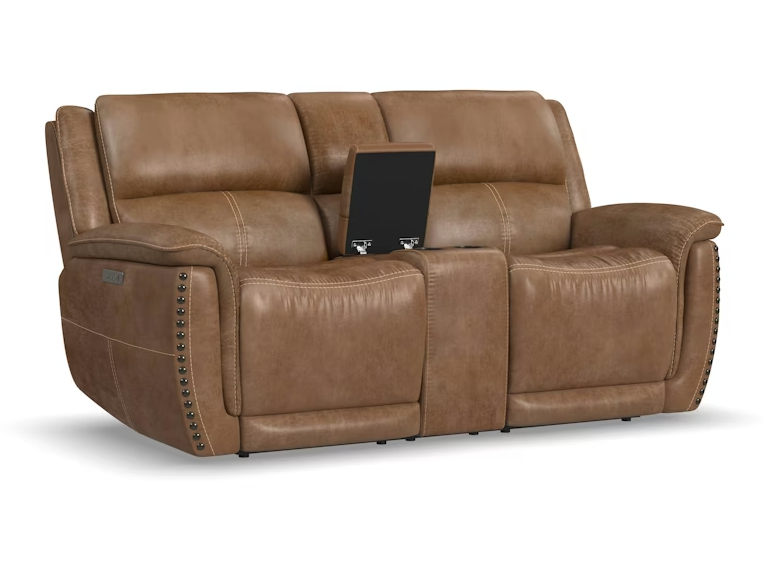
Palliser’s reclining sectionals can be customized with power headrest, lumbar, and USB charging. The customization lets you build exactly what you need.
Serafina custom sectionals can be built with reclining seats in any configuration, giving you ultimate flexibility if you have specific space or feature requirements.
HTL leather sectionals currently on clearance offer good value if you’re budget-conscious.
Making Your Configuration Decision
Start by measuring your room and understanding your space constraints. Sketch your room layout or use painter’s tape on the floor to mark where the sectional will sit.
Decide on LAF vs. RAF based on which direction the sectional needs to face in your room.
Choose your shape (L, U, or modular) based on seating needs and available space. Be realistic about how many people actually use the room regularly.
Decide where reclining seats go. Don’t pay for recliners in every position if certain seats won’t be used that way.
Consider power vs. manual based on your budget, usage patterns, and willingness to manage power cords.
Visit Salt Creek to see configurations in person. The team can help you work through the options and ensure you order pieces that actually fit your room. Getting the configuration right the first time beats dealing with returns and reorders.