

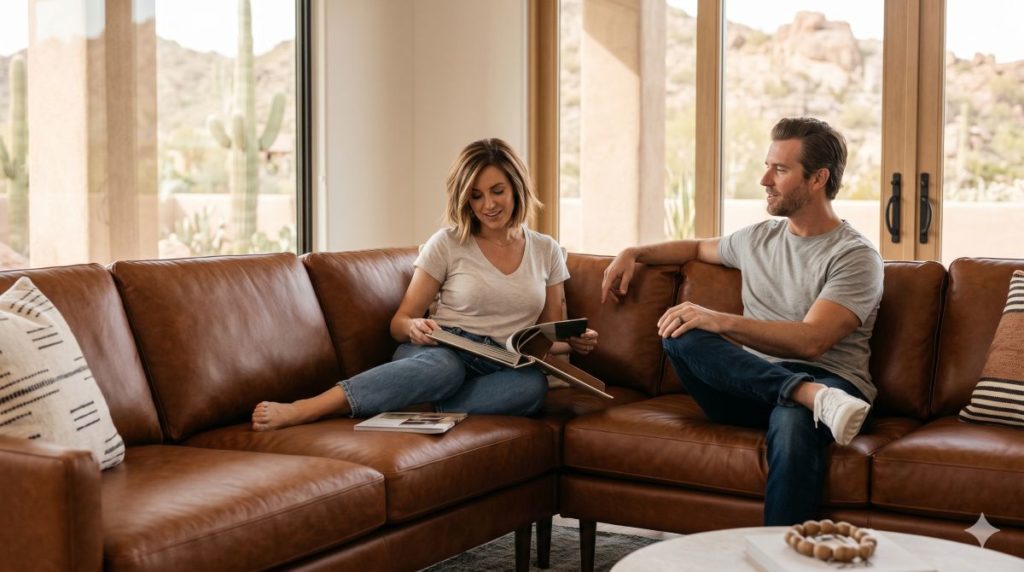
Leather furniture holds up beautifully in most of the country. Arizona is a different situation. The combination of low indoor humidity, intense UV exposure, and air conditioning that runs year-round creates conditions that dry and age leather faster than almost anywhere else in the United States. If you’re shopping for leather furniture near me in the Phoenix area, knowing what those conditions demand before you buy is what separates a sofa that looks great at ten years from one that’s cracking at three.
What Arizona’s Climate Actually Does to Leather
Most guides about leather furniture are written for climates with 40 to 60 percent indoor humidity. Phoenix in July is not that. On a typical summer day in the Valley, outdoor humidity can hover around 10 percent or lower. Run the air conditioning for a few hours, and indoor humidity in a well-sealed home can drop into single digits in rooms with older HVAC systems or poor ventilation.
Leather is skin. Like skin, it has natural oils that keep it supple, and those oils evaporate faster in dry air. In a humid climate, that process is slow enough that conditioning once or twice a year keeps pace with the loss. In Arizona, it doesn’t. The leather stiffens, the surface becomes brittle, and fine cracks form at seam lines and fold points. By the time you see the cracking, the damage has usually been building for six months or more.
Three things accelerate the process in Arizona homes specifically.
The air conditioning system is the first and most overlooked. AC units cool by removing humidity from the air. A sofa positioned in the direct airflow of a ceiling vent or within a few feet of a return air register is continuously dehumidified for hours every day. Most people don’t think about where their vents are when they arrange furniture, but for leather, this placement decision is one of the most consequential you’ll make. Six feet of clearance from a ceiling vent is a reasonable minimum.
UV exposure is the second. Arizona sits at a lower latitude than most of the continental United States, which means a more direct angle of the sun for more months of the year. West- and southwest-facing windows, which are common in homes built to capture desert or mountain views, bring in late-afternoon light intense enough to fade and dry leather in patches. UV damage to leather is cumulative and largely irreversible. Dark leather fades to a muted, chalky version of its original color. Light leather develops a yellowish cast. Neither is fixable without professional restoration.
Temperature swings are the third. It might be 100 degrees outside and 70 inside with the AC running. The leather surface responds to that differential. Over the years, repeated expansion and contraction stress the surface coating on top-grain leather and draw moisture from the fibers of full-grain leather if conditioning doesn’t keep pace.
None of this is an argument against leather. It’s an argument for buying the right grade, placing it correctly, and caring for it on the right schedule for this specific climate.
Understanding Leather Grades Before You Shop
When you walk into a Phoenix-area showroom, you’ll encounter terms that can feel confusing: full grain, top grain, genuine leather, leather match, bonded leather. What matters isn’t just what these terms mean in a technical sense, but what they mean for a piece of furniture living in an Arizona home for the next ten to twenty years.
Full-grain leather is the outermost layer of the hide, left essentially as it is. No sanding, no buffing to remove imperfections. You’ll see the natural grain, occasional marks from the animal’s life, and variation from section to section. Full-grain is the most durable leather available. It’s also the most breathable, which matters in a dry climate because breathability allows the leather to exchange small amounts of moisture with the surrounding air more naturally, buffering against extreme humidity swings. Over years of use, full grain develops a patina, deepening in color and character. The tradeoffs are real: it needs conditioning more often in Arizona than in humid climates, and it shows scratches more readily than processed leathers.
Top grain leather is the same outermost layer of the hide, but sanded lightly to remove natural imperfections and coated with a protective finish. The result is a more uniform, consistent appearance and a surface that resists staining and minor moisture better than raw full grain. That surface coating also provides some buffer against UV and desiccation. For many Arizona households, top grain is the more practical choice, specifically because of that protective coating. Bradington Young, one of the premium leather lines carried at Salt Creek, builds its stationery pieces with semi-aniline top-grain leather, which strikes a good balance between durability and a natural feel.
Genuine leather sounds like quality assurance, but it isn’t. The term refers to leather made from the lower layers of the hide after the top grain has been removed. It’s technically real leather, but it’s the least durable real leather available. It wears faster, cracks sooner, and performs poorly under dry conditions.
Bonded leather is a manufactured material made from leather scraps and fibers bonded with polyurethane and adhesive. In moderate climates, bonded leather might hold together for several years. In Arizona’s dry heat, the adhesive degrades, and bonded leather typically starts to peel and flake within two to three years of regular use. It is not a good choice for the Arizona climate at any price point.
Leather Match: What It Is and Why It Matters Here
Most leather sofas on the market, including many at significant price points, are not made entirely from leather. They’re “leather match,” which means the seating surfaces where your body makes contact are genuine leather, while the back, sides, and sometimes the outer arms are made of vinyl or polyurethane, matched to the leather’s color and texture.
Leather match is a standard industry practice and a reasonable trade-off. On a sofa positioned against a wall, you’ll never see or feel the back panel. The price difference between a full leather piece and a comparable leather match piece can be substantial, and for most households, a leather match is completely appropriate.
In Arizona, though, the seam between leather and vinyl carries a specific risk worth understanding. Leather and vinyl expand and contract at different rates under temperature and humidity cycling. Over the years, Arizona’s conditions stress the seam lines. The edges of leather sections can begin to separate or curl away from the vinyl sections, and once that process starts, it doesn’t reverse on its own.
If you’re buying a piece that will float in the middle of a room with the back visible, if you’re investing at a price point where you expect 15 or more years of use, or if the piece will see significant temperature cycling near a vent or window, ask explicitly whether it’s full leather or leather match. Any quality showroom can answer that directly. If the answer is vague after you press, treat that as information.
The Care Commitment in Arizona
Standard leather care guidance recommends conditioning every six to twelve months. In Arizona, that schedule won’t keep up with what the climate demands. In a home where indoor humidity drops below 20 percent for months at a time, leather benefits from conditioning every two to three months to replace the oils the dry air continuously pulls out.
The routine itself is straightforward. Wipe the surface with a slightly damp cloth to clear dust and surface grime, let it dry fully, then work in a quality leather conditioner with a soft cloth in circular motions. A sofa or sectional takes 20 to 30 minutes. The consequences of skipping accumulate quietly. Leather that dries out once and gets reconditioned recovers reasonably well. Leather that goes 18 months without conditioning in an Arizona home develops micro-cracks at seam lines and fold points that don’t fully close when you finally apply conditioner.
Placement matters as much as frequency. Keep the piece at least six feet from ceiling vents and out of the direct airflow of return air registers. Treat west and southwest-facing windows with UV-filtering shades or film. If the sofa has to go in a sun-exposed position, a UV-protective leather treatment applied alongside regular conditioning adds meaningful protection.
What This Means for the Leather vs. Fabric Decision
If you’re still deciding between leather and fabric, the comparison looks different in Arizona than it does in most of the country.
The “leather gets too hot” argument that fabric advocates typically raise is weaker here than in humid climates. What makes leather uncomfortable isn’t heat alone but humid heat. Arizona’s heat is dry. A leather sofa that hasn’t been in direct sunlight in a conditioned room is comfortable throughout the year for most people. The issue in Arizona is direct sun on the leather surface, which is a placement question, not a material question.
Performance fabrics have improved significantly over the last several years and are a genuinely strong option for Phoenix homes. But fabric of any kind traps fine dust, pollen, and allergens in a way that leather doesn’t, and the Valley’s dust season is real. Leather wipes clean. Fabric holds onto what settles into it.
If You’re Buying a Sectional: How the Decision Changes
A leather sectional carries more visual weight than a fabric sectional of the same dimensions. In an open floor plan, which is common in Arizona new construction, that presence can be an asset. A leather sectional anchors a great room in a way fabric often can’t match.
But the configuration decision, specifically which direction the chaise faces and whether you go L-shape or U-shape, needs to account for your room’s natural light and AC vent locations, not just walls and walking paths. A leather chaise positioned to face a west-facing window experiences significantly more UV exposure than one angled away from it.
What to Pay Attention to in the Showroom
Shopping for leather furniture requires more time in person than almost any other furniture category. Here’s what actually matters when you’re there.
Sit on the piece for at least 10 to 15 minutes. Leather takes longer than fabric to communicate its comfort level. It should feel supportive without being rigid, and the seat should hold its shape under your weight without compressing unevenly toward the frame. If you feel the frame through the cushion when you shift positions, that’s a concern regardless of how the leather looks.
Ask what grade of leather is used and where. A quality showroom should give you a direct answer: full grain or top grain, full leather or leather match, where the non-leather materials begin. If the answer stays vague after you press, take that seriously.
Run your hand along the seam lines. Tight, consistent stitching without puckering or pulling is a sign of quality construction. Loose or uneven stitching will work open faster under regular use and during the expansion-contraction cycles that Arizona’s conditions create season after season.
Feel the back panel and outer arms. If the texture shifts noticeably from the seat surface, you’re touching leather match. That’s not disqualifying, but it should factor into the price you’re willing to pay and your expectations for the piece’s longevity in this climate.
A Note on Price: What Quality Leather Actually Costs
One of the most useful things to know before you shop is what a genuine quality leather piece should cost in today’s market, because bonded leather and genuine leather furniture are often priced close to real top-grain pieces, and the visual difference at a glance can be small.
A quality top-grain leather sofa from a reputable brand runs roughly $2,000 to $4,500 in the current market. A leather sectional in top grain typically starts around $3,500 and climbs from there depending on size and configuration. Full-grain leather adds a meaningful premium at each tier.
If you encounter a “leather” sofa priced at $800 to $1,200, it’s almost certainly bonded leather, lowest-grade genuine leather, or leather match with very limited leather coverage. That may suit your situation fine. It won’t hold up in an Arizona home the way a top-grain or full-grain piece will, regardless of how it looks in the store.
What Salt Creek Carries
Salt Creek’s leather lineup covers the full range from solid everyday pieces to long-term investment furniture, with brands chosen specifically for their leather quality rather than their general catalog.
Eleanor Rigby Home is the leather sofa anchor of the collection. The GTR Full Leather Sofa uses genuine leather on all surfaces, not just the seating areas, which puts it in a different category than most comparably priced pieces. The Eleanor Rigby Suzie Sectional is also full leather and configurable for different room orientations. For buyers who want full leather coverage throughout, this is where to start.
Bradington Young is the investment-grade option. Their stationary pieces are built in Hickory, North Carolina, using eight-way hand-tied coil spring construction and more than 135 leather options across grades and finishes. This is the brand for a buyer who is purchasing once and keeping the piece for twenty years. The leather quality and construction standards reflect that expectation.
Palliser brings leather into the power motion category. The Reece Power Sofa in leather with power lumbar and headrest is on the Scottsdale floor. For buyers who want the material quality of leather with the comfort functionality of a reclining piece, Palliser does this combination well.
HTL specializes in leather sectionals, including power reclining configurations. Notably, HTL operates their own leather tannery, giving it more control over material consistency than most brands that source leather from third-party suppliers. The leather power-reclining sectional at the Gilbert location is a strong value for its price point.
Browse the leather sectionals collection online for a starting point, but plan to see leather in person before you decide. Color, texture, and how a piece actually feels under your hands are things a product photo can’t communicate.
Planning the Room Around the Leather
Before you visit a showroom, measure your room and think about where the piece will actually live day-to-day. Note the ceiling vent locations. Note which windows get direct afternoon sun and from which direction. Know where the TV wall is if you’re orienting seating around one.
A leather sectional in a Phoenix living room can be a genuinely beautiful piece of furniture that improves with age. The same sectional placed under an AC vent with afternoon sun hitting it from a southwest window will look noticeably worse within a few years. The room comes before the sofa.
Our guide to leather sectionals in Phoenix living rooms covers specific layout scenarios for open floor plans and great rooms, including how to handle light and vent placement questions that come up in Arizona homes.
What Most People Get Wrong About Buying Leather in Arizona
The most common mistake isn’t buying the wrong grade. It’s buying the right grade and then placing the piece where the climate will work against it every day.
A buyer who does their research, chooses a quality top-grain piece from a reputable brand, and brings it home to a room where it sits six inches below a ceiling vent and faces a west-facing window has made a good furniture purchase and set it up to fail. The leather will be dry and showing fine surface cracks within two to three years. The frustrating part is that the piece isn’t defective. The environment is just more demanding than the setup accounts for.
The second most common mistake is buying at a grade that doesn’t fit the household’s reality. Full-grain leather in a home with three young children and two large dogs is not a wrong choice if the buyer understands the commitment. It is a wrong choice if the buyer expects it to be as forgiving as top-grain under daily abuse. Matching the grade to the household’s actual use patterns, rather than to an aspiration, yields better long-term satisfaction.
The third mistake is treating the price of the leather as the primary quality signal. A leather sofa priced at $3,000 with a composite frame and bonded leather will not outperform a $2,000 piece with a kiln-dried hardwood frame and genuine top-grain leather. Grade and construction matter more than the number on the tag.
The Buying Timeline: What to Expect with Quality Leather
If you’re shopping for a quality leather sofa or sectional, understanding the timeline sets realistic expectations and prevents rushed decisions that lead to regret.
In-stock leather pieces, typically what you see on a showroom floor in a specific color and configuration, can often be delivered within two to four weeks. These pieces are ready to go and represent what the manufacturer had on hand or what the retailer purchased for display. If the color and configuration shown match your room, this is the fastest path.
Custom or made-to-order leather pieces, where you choose a frame, leather grade, color, and options, take longer. Depending on the brand and their current production schedule, lead times typically run eight to fourteen weeks for quality American-made leather furniture. Bradington Young, for example, builds their pieces to order in Hickory, North Carolina, which means a longer wait but also a piece built precisely to your specifications in the leather you chose.
For most buyers who are furnishing a room they’ll live in for a decade or more, eight to twelve weeks is a reasonable wait for a piece that’s exactly right rather than close enough. The pressure to get something in the room quickly is understandable, but it’s one of the more reliable drivers of furniture regret. A piece that arrives in three months and fits the room perfectly will be more satisfying than one that arrives in three weeks and sits slightly out of place.
If timing is a constraint, ask specifically about in-stock or quick-ship options. Several of Salt Creek’s leather brands maintain in-stock inventory of popular configurations and leathers, which can be delivered significantly faster than custom builds.
Frequently Asked Questions
Is leather furniture a good choice for Arizona homes?
Yes, with the right grade and care routine. Top grain and full grain leather both perform well in Arizona when conditioned every two to three months and placed away from direct AC airflow and afternoon sun. Bonded leather and lowest-grade genuine leather are poor choices for the Arizona climate.
How often should I condition leather furniture in Phoenix?
Every two to three months, rather than the six to twelve months listed on most care labels. Standard recommendations assume normal humidity. Arizona conditions, particularly during summer with air conditioning running for months continuously, deplete leather’s natural oils faster than standard schedules account for.
What’s the difference between full leather and leather match?
Full leather means all visible surfaces are genuine leather. Leather match uses genuine leather on seating surfaces where your body contacts the sofa and a vinyl or polyurethane material on the back, sides, and outer arms. Both are common in quality furniture. In Arizona specifically, leather match pieces develop seam stress faster than full leather pieces because the two materials expand and contract at different rates through temperature and humidity cycling.
Can a leather sofa go near a window in Arizona?
It can, but west and southwest-facing windows deserve real caution. UV damage to leather is cumulative and not reversible. If placement near a sunny window is unavoidable, UV-filtering window film or shades make a meaningful difference, and a UV-inhibiting leather treatment applied during conditioning adds another layer of protection.
How do I know if a leather sofa is worth the price?
The leather grade, frame construction, and spring system together determine value. A piece with top grain or full grain leather, a kiln-dried hardwood frame, and quality spring construction will outlast most other furniture in the house with proper care. A piece with a composite frame and bonded leather won’t, regardless of the price tag.
What questions should I ask in a showroom?
Ask whether the piece is full leather or leather match. Ask what grade of leather is used on the seating surfaces. Ask about frame material and spring construction. Ask about the warranty on both the frame and the leather. Any showroom that sells quality leather furniture should be able to answer all of those questions directly and without hesitation.